
Discovering that your child has slipped capital femoral epiphysis (SCFE) or slipped upper femoral epiphysis (SUFE) can be overwhelming.
Our goal is to offer guidance to help you and your child through their SCFE/SUFE journey and provide support along the way.
On this page you will find:
What is SCFE/SUFE?
Why Does it Happen?
How is SCFE/SUFE Detected?
Treatment of SCFE/SUFE
How Will SCFE/SUFE Affect My Child?
Sharing the News
Support
Resources
What is SCFE/SUFE?
SCFE/SUFE is a rare condition, affecting about 1 in 1000 children during their lifetime.
It is a condition which affects the hip where the growth plate (physis) at the top of the thigh bone (femur) slips from the top of the thigh bone. The change in position of the growth plate then allows the rest of the thigh bone to slip out of the socket, leaving the separated end of the ball part of the hip in the socket. This causes the rest of the thigh bone to twist forwards and outwards, leaving the hip in a dangerous position.
The condition more commonly affects one side (unilateral) but can affect both hips (bilateral).
Why Does it Happen?
Obesity is a common cause of SCFE/SUFE because the increased weight puts more pressure on the developing hip joint.
Rapid adolescent growth and other hormonal or metabolic conditions can also cause SCFE/SUFE.
How is SCFE/SUFE Detected?
Symptoms of SCFE/SUFE can be easy to miss.
The first sign of SCFE/SUFE is often a pain in the groin area, but pain can sometimes be felt in the thigh or knee, due to the pain signals travelling down a nerve in the leg.
Other signs of SCFE/SUFE include a waddling walk and trouble moving the leg in all directions.
Diagnosis is usually by X-ray and physical examination of the hip. The condition is often graded on the stability of the hip (determined by the child’s ability to walk unaided) and how much the bone has slipped out of place. The hip is said to be unstable when walking is not possible, even with crutches.
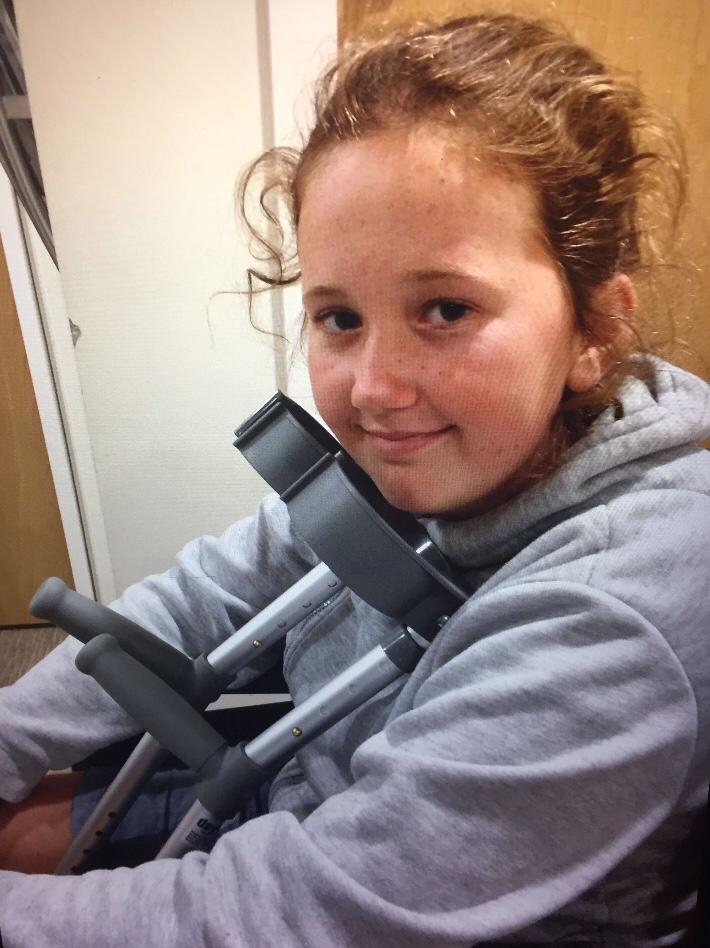
Read Lauren’s story about her diagnosis and treatment for SCFE/SUFE here.
Treatment of SCFE/SUFE
An operation will be needed to stabilise the joint in the affected hip and prevent further damage. If there is thought to be a significant risk of slippage in the unaffected hip, surgery will be performed to prevent this.
If the slip is ‘unstable’ then surgeons may decide that a period of bed rest is most appropriate before attempting surgery.
If the slip is significant (assessed by the surgeon) or the child is especially young, surgeons may use a ‘growing’ screw to allow the amount of slip to correct with growth – though this will require close monitoring, and possibly further surgery.
Bed-rest and pain relief are commonly used to alleviate symptoms.
Steps have produced a downloadable factsheet on SCFE/SUFE for families affected by the condition. Steps have also produced a guide – Preparing For Your Child’s Surgery to help parents and carers prepare themselves and their child for a hospital admission.
How Will SCFE/SUFE Affect My Child?
The condition is unlikely to return following treatment, but your child will be routinely monitored throughout their growth.
Following surgery, your child should avoid high impact activities (such as running and jumping) until the consultant advises that normal daily activities can resume.
If your child is considered overweight, it is important that encouragement is given to achieve a healthier weight. Information and support is available from NHS sources.
If SCFE/SUFE is not treated, it may lead toa condition called avascular necrosis (AVN) which can be painful and impact walking patterns. In severe cases, there may be an increased risk of osteoarthritis in adulthood.
Find out more about SCFE/SUFE in our webinar
Sharing the News
When and how you tell close family, friends and other relatives about your child’s condition is a very personal decision which will be impacted by how and when the diagnosis occurred, the individual prognosis for your child and the potential treatments available.There is no right or wrong way or time to share the news, however, being well informed about the condition and having the opportunity to connect with other parents who can understand what you are feeling will likely help.
Once you do share the news, your relatives and friends will probably want to know how they can support you and your child, so take advantage of the experiences being shared by other parents, to help you feel better equipped to answer such questions and get the support that is right for you.
Support
Steps is here to offer emotional and practical support.
The Steps closed Facebook Group is a friendly and safe way of discussing your worries, sharing tips and finding emotional support. Our Family Contact Service identifies someone else who has been through a similar situation and who’s happy to talk about their experiences, on a one-to-one basis, to offer support.
You can reach out to Steps with your questions, concerns and requests via email info@steps-charity.org.uk or leave a voicemail message on 01925 750271 and one of the team will be in touch.
All our SCFE/SUFE links and related resources can be found below


)